Xtreme 3.0 Conference: From Scale to Mature Growth
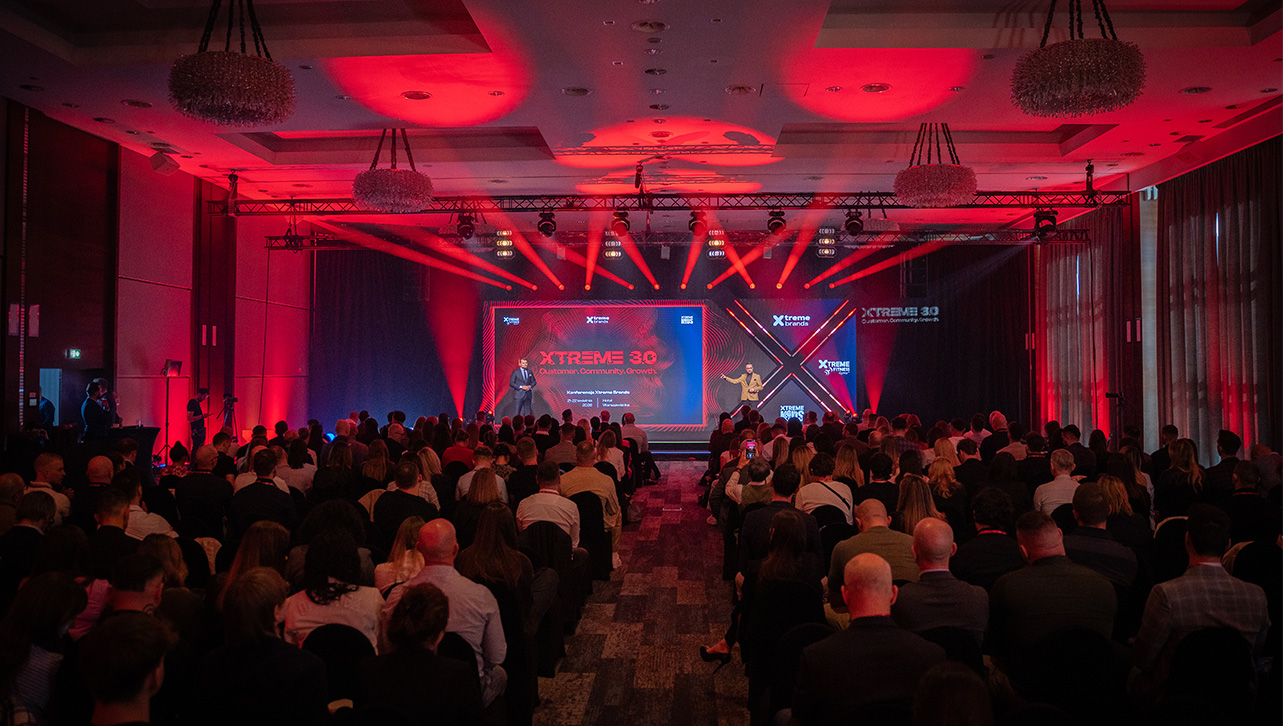
400 attendees, 200 franchise partners, and two days of conversations about customers, community and strategic direction – the third edition of the Xtreme Brands conference, Xtreme 3.0: Customer. Community. Growth., took place in Jachranka, near Warsaw.
At some point, a fast-growing network has to answer a harder question than ‘how many new locations will we open in the near future?’ It has to ask: how do we keep growing without sacrificing quality, energy, and connection with the customer?
That challenge was at the heart of this year’s Xtreme Brands gathering, held on 21–22 April at the Warszawianka Hotel in Jachranka. The conference brought together nearly 400 people – including over 200 franchisees, as well as representatives from operations teams, business partners, and invited guests.
The central theme of the event was the tagline Xtreme 3.0: Customer. Community. Growth. – which signals the organisation’s direction going forward. This was not just a conference theme, but a declaration of intent. Xtreme Brands – operating two franchise concepts, Xtreme Fitness Gyms and Xtreme KiDS – is entering the next phase of scaling; one in which the sheer number of new locations is no longer the sole measure of success. What takes centre stage now is customer experience, operational quality, technology, partner development, and building strong local communities around its gyms and children’s spaces.
Scale That Demands Maturity
For Xtreme Brands, 2025 marked the transition from a phase of rapid growth to one of mature scaling. Over the course of twelve months, the group launched 64 new locations – 57 Xtreme Fitness Gyms clubs and 7 Xtreme KiDS venues – further cementing its position as one of the fastest-growing franchise systems on the Polish market.
The network now comprises 170 Xtreme Fitness Gyms clubs and 14 Xtreme KiDS play centres. Xtreme Fitness Gyms has also crossed the milestone of 100,000 active members, which clearly illustrates just how dramatically the scale of operations has shifted. This is no longer simply about rolling out new locations – it is, above all, about managing the experience of a large, active customer community.
Further ambitious expansion is planned – both in Poland and internationally. This year, Xtreme Fitness Gyms enters the Czech Republic, opening its first locations outside of Poland. The group’s long-term goal is to reach 750 locations across both concepts by 2030. That is an ambitious target, and one that requires not just capital and good real estate, but also proven, scalable processes, robust franchise partner support, and the consistent upholding of high standards across an ever-larger organisation.
This direction was made clear from the very opening of the Xtreme 3.0 conference. James Cotton and Łukasz Nowakowski spoke about the future of the fitness industry in Poland, the growing public awareness around health, and the pivotal moment at which physical activity is shifting from a lifestyle add-on to an absolute cornerstone.
The fitness industry – and wellness more broadly – is experiencing the highest level of interest in its history. We want to make the most of this moment by creating the conditions for our franchise partners to grow their businesses, and for customers to have the best possible spaces to achieve their goals – said James Cotton, CEO of Xtreme Fitness Gyms and Xtreme KiDS.
Customer: The Customer as the Point of Reference
The first pillar of Xtreme 3.0 is the customer. From this point of view, a fitness club is no longer simply a facility with good equipment, just as a play centre is no longer merely a place where a child can spend time. Both concepts must respond to the increasingly discerning expectations of their audiences.
For Xtreme Fitness Gyms, this means working across the entire customer journey: from the first touchpoint with the brand, through the visit to the club, the conversation at reception, the first workout, subsequent activities, all the way to the decision to renew a membership. Each of these moments builds a relationship and shapes trust in the brand. In a franchise model, this matters enormously, because the brand does not exist solely in head office strategy. It lives locally: in conversations with members, in the quality of service, in the atmosphere of each venue, and in the day-to-day decisions of each manager.
A key part of the Xtreme 3.0 programme was a presentation by Paweł Tkaczyk, brand strategist and communications expert, who examined customer service as a complete, end-to-end process – from the first point of contact through to membership renewal. This perspective is especially relevant in the fitness industry, where selling a membership does not conclude the relationship – it merely begins it. The real value is created afterwards, when the customer keeps coming back, feels seen, understands their goal, and has a reason to stay part of the club community. In that sense, customer experience is not a soft add-on to the business. It is one of the fundamental drivers of retention, referrals, and competitive advantage.
Community: A Network of Entrepreneurs and Local Communities
The second pillar of the conference was community – a concept understood in multi-layered terms at Xtreme Brands. It starts with the franchise partners – entrepreneurs running local businesses who are simultaneously co-creators of a broader, cohesive system. The next tier consists of club teams: managers, trainers, activity leaders, and play centre staff, who shape the customer experience on a daily basis. The third, equally important group is the customers themselves – gym members, parents, and children – around whom all of the brand’s efforts ultimately revolve.
In a well-functioning franchise network, these groups do not operate in isolation, they form a coherent ecosystem in which local energy meets central support, standards, and know-how. This is precisely why the concept of franchisee-centricity resonated so strongly throughout the conference – an approach that means designing processes, communications and tools from the perspective of the franchise partner.
This thread was developed by Joanna Procyszyn and Katarzyna Kożuch, who emphasised that a mature franchise network cannot be managed from the top down alone. Understanding the day-to-day realities of the partners’ work is essential – from the pressures of the local market, through team management, sales and retention, to maintaining high service standards, running marketing activities, and having quick access to the right knowledge. It was in this context that one of the key announcements of the conference was made: a new knowledge base for franchisees, designed to consolidate standards, procedures, documents, guidelines and best practices. At a network approaching 200 franchise partners, tools like this are no longer optional – they become a cornerstone of efficient, effective network management.
A natural extension of this approach is the ambassador programme, which goes well beyond conventional promotional activity. Its essence lies in capturing and channelling what already exists organically within the franchise network: local stories, partner engagement, team spirit, and authentic customer experiences. These are precisely the things that build brand credibility far more powerfully than any centrally produced message.
In a mature franchise, the brand is not built centrally alone. It is built locally – in the clubs, in relationships with customers, in the work of teams and in the commitment of franchise partners. The ambassador programme is designed to help us harness that potential more deliberately. We want to amplify the people who genuinely carry Xtreme Brands’ values and can demonstrate that behind our scale lie real experiences, real stories, and real results – said Filip Puchalski, Commercial Director of Xtreme Fitness Gyms.
Community also had a more informal dimension. The second day of the conference opened with group workouts – seemingly a small detail, but meaningful. In an organisation that champions health, movement, and quality of life, shared physical activity is more than symbolic. It is part of the brand’s language and a natural extension of its values.
Growth: Progress Beyond Opening Numbers
The third pillar – growth – could easily be reduced to the number of new locations. For Xtreme Brands, however, that would be far too narrow a reading. Growth here encompasses several parallel processes: network expansion, entry into new markets, building partner capabilities, raising operational standards, investing in technology, and developing the broader brand ecosystem. During the conference, a number of announcements were made: a new website, an upcoming mobile app, new strategic partnerships, and the addition of another brand to the Xtreme Brands portfolio.
This marks an important shift. An organisation targeting 750 locations by 2030 cannot build its growth on new openings alone. It must grow through its system: through data, technology, standards, leadership, and the capacity to learn across the entire network.
This direction was given its most powerful expression during the evening gala, which Łukasz Dojka opened with a presentation entitled ‘Vision 3.0’ – a symbolic closing of the conference’s overarching narrative. On the one hand, it reflected on the pace of growth achieved so far; on the other, it signalled the organisation’s entry into the next level of operational maturity. Xtreme Brands affirms its commitment to continued growth, but with increasing emphasis on the quality of that growth – founded not only on expansion but on customer experience, technology, and the strength of its franchise partners.
Xtreme 3.0 is the moment at which scale must go hand in hand with maturity. Over the past few years, we’ve proven that we can grow the network quickly, open new locations, and build a strong franchise model. Now our task is to move up a level: to develop the brand ecosystem, invest in technology, strengthen our standards, and create conditions in which franchise partners can grow alongside us. Our ambition is not simply to add more locations. We want to build the leading franchise brand in the wellbeing space across Central and Eastern Europe – said Łukasz Dojka, founder and owner of Xtreme Brands.
The gala also featured an awards ceremony, recognising, among others, the best club member, best club, and the best pre-sales campaign. These categories illustrate how broadly Xtreme Brands defines success – through results, the quality of local team performance, sales effectiveness, and customer engagement. Viewed this way, growth is no longer just a statistic of openings. It is a product of the entire system working well, day in, day out – from strategy and operations through to the local customer experience.
Xtreme KiDS: Activity Over Screens
A distinct and important thread running through the conference was the development of Xtreme KiDS. The children’s play centre concept is part of Xtreme Brands’ broader thinking around wellbeing – not just for adults, but for families and the youngest generation alike.
Craig Jones, Xtreme KiDS Children & Young People Support Partner, spoke about the direction the children’s brand is heading. It was a significant contribution, because the family activity space is itself evolving. Parents are increasingly looking for more than just a place where their child can burn off energy. They are looking for a safe, well-structured, engaging, and enriching environment – a place that gives children movement, peer interaction, and healthy habits, free from screens, from randomness, and from chaos.
In this sense, Xtreme KiDS can be described as a ‘fitness club for children’ – though not in any literal sense. It is more about creating a space where physical activity becomes a natural part of childhood. For Xtreme Brands, it also represents a consistent broadening of scope: from fitness clubs for adults to a whole-family ecosystem of activity and healthy habits.
Leadership Under Pressure
One of the conference’s special guests was Krzysztof Hołowczyc, who spoke on the mindset of a champion and the ability to turn challenges into genuine growth. In a programme like this, it would be easy to treat such an appearance as a standard motivational slot – but in the context of franchising, it took on a far more practical dimension.
Running a fitness club or a play centre means working under constant pressure: from results, from the team, from customers, from local competition, from seasonality, and from the demands of operational quality. As in sport, raw talent or a one-off burst of effort is never enough. What counts is preparation, consistency, resilience, sound decision-making, and trust in the team.
This is especially relevant at a time when the topic of multi-unit franchisees is growing more prominent within the network. Running a single location and managing several sites are two fundamentally different stages of entrepreneurship, each requiring a different rhythm of work, a different approach to delegation, and a more developed level of leadership maturity.
Responsibility That Grows With Scale
The Xtreme 3.0 conference went beyond operational and sales topics. A panel featuring Omena Mensah, Ewa Chodakowska, and Łukasz Dojka also addressed the subjects of corporate social responsibility, charitable activity, and giving back to those in need.
This was not a topic disconnected from the business. As an organisation grows, so does its reach – over customers, partners, local communities, and the broader social environment. For brands centred on health, movement, and personal development, that reach is especially visible. Xtreme Brands does not merely provide access to facilities – it creates spaces where people work on their fitness, their wellbeing, their relationships, and their daily habits.
Omena Mensah and Ewa Chodakowska were particularly compelling voices in this conversation, having both built strong personal brands extending well beyond any single area of activity. They combine entrepreneurship, public profile, and social commitment. Their presence on the panel demonstrated that scale can be more than a tool for business growth – it can be a means of amplifying initiatives that have real impact beyond the marketplace.
The Conference as a Network Management Tool
In a large franchise network, a conference does not serve an integrative function alone. It is, above all, a management tool – an opportunity for the organisation to synchronise, sharpen its priorities, set direction, review results, and reinforce a sense of shared purpose between head office and its partners.
The third edition of the Xtreme Brands conference was exactly that. On the one hand, it put the scale on display: 64 locations opened in 2025, over 200 franchise partners, more than 100,000 active members, plans to enter Central and Eastern European markets, and a target of 750 locations by 2030. On the other, it shifted the conversation away from pure expansion and towards the quality of growth.
That shift matters now more than ever. In the franchise model, the pace of growth is important, but it cannot be the only measure of success. The strength of a network is determined by its ability to maintain standards across many locations, to support partners in their day-to-day management, to develop team capabilities, and to deliver a customer experience that remains consistent regardless of which city you are in.
Xtreme 3.0 demonstrated that the next chapter of Xtreme Brands’ development will be built on precisely that logic. Opening more clubs and play centres is not enough. What matters is building places people want to return to; a community they want to be part of; and a franchise system that gives partners the real tools to run an increasingly demanding business.
Because a brand does not grow simply by appearing on the map in more and more locations. It grows when, in each and every one of them, it can deliver on the quality, the promise, and the experience that stand behind its name.